सोमवार, आश्विन १२ २०८३
Introduction
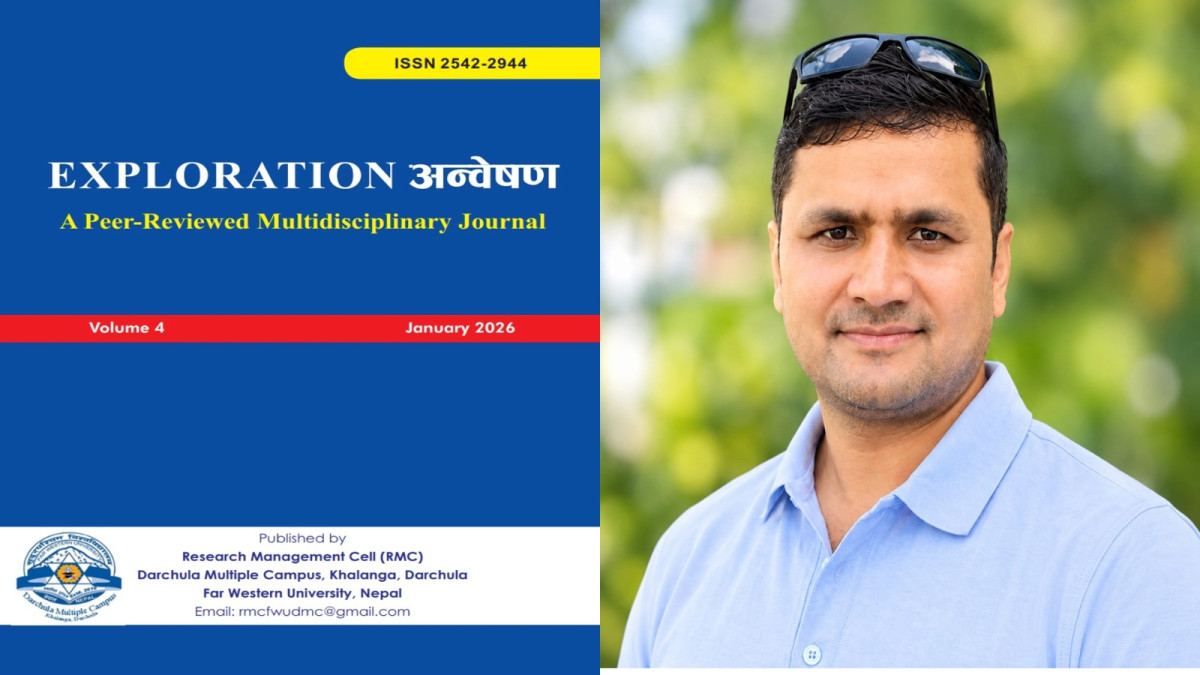
Being both the Chairperson of the Research Management Cell as well as Editor-in-Chief of Volume 4 of the multidisciplinary peer-reviewed journal of Darchula Multiple Campus, Far Western University, was more than just an editorial job. It was a continuous journey of academic reflection, institutional learning, negotiation and professional development. When Volume 4 was published in January 2026 with twenty peer-reviewed articles from English education, literature, management, social sciences and humanities, it provided a chance to explore not just the way a multidisciplinary journal is created, but also what it reveals about the changing nature of research culture at a university set in a geographically distant location.
When I first entered the editorial process, I knew what it entailed primarily as an organisation of manuscripts, reviewers, revisions and publication needs. As it evolved, my understanding of editorial leadership has grown, though. The editor was becoming a more than just a quality control agent for academic quality; he was a facilitator of scholarly conversation, a mediator between the different disciplinary visions, and a steward of institutional knowledge. It showed that creating such a credible academic journal is far more than just gathering manuscripts and arranging them for publication. Needs patience, judgment, moral responsibility, communication and skills in negotiating differing viewpoints and maintaining common standards of learning.
From Institutional Publication to a Shared Research Space
Exploration अन्वेषण has become a significant institution for sharing research knowledge from Far Western University and beyond. The journal is published annually by the Research Management Cell and is an open-access, double-blind, peer-reviewed multidisciplinary journal. Twenty studies on a variety of academic and social issues were collected in Volume 4. This interdisciplinary nature was especially notable because of the diversity of articles, which were not of a single intellectual background. These included different research questions, methodological approaches, theories, and disciplinary jargon.
I thought of this diversity, and I realised that the journal was not only a completed research storehouse. It was more effectively a space where different knowledge could meet and interact, a place where we could think together. The studies on artificial intelligence and English language teaching were complemented with studies on management accounting, literature, education, ageing, public-school practices, social change, investment decisions, and other fields, which showed the diversity of research conducted within and beyond the university. The editorial work was not to obliterate disciplinary distinctions but to establish the circumstances in which the distinctions might be viable in a shared ethos of scholarly discipline.
I also experienced how institutional research has been transformed in this particular experience. Research culture is not just created in mega projects, conferences or formal research policies. It is also constructed with the support of modest, but enduring, institutional activities: from fostering colleagues' writing, providing opportunities for colleagues to review before publication, and providing support for the publication of colleagues' work, to making research available to broader audiences. In this way, the journal was the result of institutional research activity, and at the same time it was a tool to reinforce that same institutional research activity.
Editorial Leadership as Academic Stewardship
Throughout the editorial process, authors, reviewers, readers and the institution had to be kept in mind and balanced. All manuscripts were initially evaluated by editors for relevance, academic merit, originality and minimal adherence to journal requirements. They were then subjected to double blind peer review, typically by two or three reviewers. All decisions were based on reviewers' recommendations, and authors were asked to revise and respond to reviewers' comments. The final step was formatting, references, metadata and other publication requirements prior to institutional approval and digital publication.
The stages seem to be steps in a process but, as I learned during the process, editorial work is, fundamentally, a relational work. Each manuscript was an investment of the author's mind and each review was a decision of another scholar's mind. Not all recommendations were consistent. Sometimes the reviewers focused on certain sections of a manuscript, and the editorial choice often involved a nuanced approach to the selection of a suggestion, rather than an automatic affirmation of it. Those times reaffirmed my grasp of the fact that no editorial judgment is independent of human interpretation. Academic quality is sought through clear standards, through knowledge and expertise of the disciplines involved and through discussion, rather than through the mantra of absolute objectivity.
So, I think editorial leadership became viewed as stewardship for me. The editor should preserve academic integrity and respect authors as emerging scholars. This is not about rigidity but firmness, and it's not about openness but scholarly integrity. It also demands acknowledging that peer review is not just a way of turning down shoddy manuscripts. It is best when it is a process that makes the manuscripts clearer, more rigorous, and more intellectually meaningful.
Negotiating Multidisciplinary Knowledge and Context
The most challenging intellectual challenge in Volume 4 was to collaborate interdisciplinarity. A multi-disciplinary journal is bound to have studies written in different conceptual language and in different methods. The integration of ChatGPT in a community school has led to a study that questions the education and training of teachers, infrastructure, digital literacy, academic integrity and ethics, to name just a few. The management accounting controls literature, the organisational literature and the statistical literature present different points of view to interpret the findings from the studies on management accounting controls, whereas the perspectives of ageing, literature, English language education, and social change are different.
I didn't see this variety as a challenge for editors, though; I slowly came to think of it as a benefit of institutions. The problem for the editors was to develop the idea of common principles that would help to tie together various scholarship types. They encompassed clear purpose, suitable methodology, substantiation of arguments, ethical research practices, reference to relevant literature, and coherent presentation. There could then be a certain diversity in disciplines while retaining a scholarly coherence.
The articles also gave me a reminder that research is not divorced from its context. The study on community schools, English-medium instruction, 'flipped classroom', artificial intelligence, college enrolment, teacher professional development, and ageing covered various changes that took place in Nepali society. Multiple studies identified a conflict between the newly available educational and technological opportunities and the existing structural constraints, including insufficient infrastructure, few educational opportunities, economic burden and unequal access to resources.
As an editor, I was inspired to think about and reflect on the need for context-sensitive scholarship by reading these books. Concepts that are good in one context may not be appropriate in another, and local institutional, cultural, technological and socioeconomic issues must be taken into account.
Technology, Artificial Intelligence, and Emerging Editorial Responsibilities
As AI becomes more prevalent, it emerged as another significant focus of reflection. The book contained several articles related to technology and educational change, such as the one on how ChatGPT is being used in community schools and the impact of artificial intelligence on teaching and sustainable development. Opportunities and concerns emerged from these studies. While AI can enhance personalised feedback, engagement, accessibility, and innovative learning styles, its successful implementation relies on the capacity of educators to prepare and foster their own abilities and capacities, alongside the availability of adequate infrastructure, digital literacy, ethical consciousness, and institutional guidance.
Such concerns also have a direct impact on academic publishing. As editorial becomes more and more about originality and plagiarism, authorship and transparency, and responsible use of tools assisted by AI, everyone must keep up with the latest developments. Plagiarism and AI-related issues thus entered the fabric of discussions regarding academic integrity during the editorial process. The experience also highlighted the need not to rely on technology as ‘assurance’ evidence. The editorial judgement should be based on the manuscript, the author's declaration (if any), ethical standards and fair procedures.
Through this reflection, I came to understand the importance of establishing more explicit policies for using AI responsibly in journals in emerging research environments. Technology should not be the substitute for scholarly judgement. Instead, it should be embraced in an ethical editorial context which respects originality and recognises the evolving landscape of academic publishing and research.
Open Access, Institutional Responsibility, and Sustainability
The partnership between accessibility and sustainability was another important aspect of the editorial process. Exploration is an open access journal and does not require authors to pay submission, processing or publication fees. The publication is funded by institutional research resources and by hard-copy sales. This model offers a great opportunity for scholars who might not have financial support for publication, specifically in areas where research funding is scarce.
As I'm doing this, however, I can't help but think about the invisible institutional labour that is necessary to maintain open-access publishing. All of this takes time and experience to coordinate, peer review, format, communicate, manage electronically, and publish. The term open access should not be understood to mean that publishing is free. Instead, its expenses are commonly met by institutions and academic labour.
This brought up a pertinent institutional issue: how can universities maintain the quality of scholarly publishing without imposing undue financial or professional strain on individual scholars? The experience indicated the need for increased digital systems, institutional support, development of reviewers, development of editorial skills, and long-term planning. Transitioning from email-based coordination to a unified journal management system like Open Journal Systems can help streamline editorial processes, improve transparency, and contribute to sustainability.
The Journal as a Mirror of Institutional and Social Transformation
The most important learning from Volume 4 was that an academic journal may be an outgrowth of its institutional and social context. The volume of research that was gathered exhibited concerns not only across disciplines, but also beyond. The factors identified in reducing college enrollment included changes in aspirations, overseas schooling, anxiety about employment, financial constraints, curriculum issues, and institutional issues. The research on the English-medium and flipping the classroom uncovered the complexities of educational aspirations, technological access, teacher preparation, and classroom traditions. The research on ageing demonstrated the impact of urbanisation, migration and evolving family dynamics on the lives of older people.
In addition, research on teacher professional development and collaboration in English found that these elements of professional learning, collegial interaction, reflection, and professional identity remained significant in teaching as a profession. The findings of all these studies pointed to the same conclusion: that universities are not "islands in the sea. These are located in dynamic social, technological, economic and cultural settings.
As an editor, I was inspired to consider the studies in concert and to think beyond the individual study results. The journal came to be a means of institutional dialogue. The various studies, while tackling different issues, all showed a society that was grappling with educational change, technological change, migration, globalisation and a changing social relationship. This strengthened my conviction that multi-disciplinary publishing could help in self-understanding and in the dissemination of knowledge, both within and beyond the institution.
Conclusion
I now see that the task of publishing Volume 4 was far more than an administrative accomplishment. It was a learning experience which transformed the way I perceive academic leadership. I learned that it takes a coordinated approach for effective editorial leadership, but coordination is not enough. It demands such intellectual openness, ethical sensitivity, sensitivity to differences in disciplines, sensitivity toward authors and reviewers, and a self-learning attitude.
The experience also highlighted some elements in need of further institutional development. The capacity of the reviewers has to be enhanced by systematic orientation and professional development. For editorial policies, plagiarism, authorship, research ethics, and AI-assisted writing, adjustments should be made in conjunction with the advancement of technology. Digital journal management should be more systematic, and there should be increased involvement of scholars from other institutions and countries, allowing for a wider intellectual reach. Meanwhile, the journal must continue to pursue research products from the local and regional context. Internationalisation should be seen as a complement, not a replacement for locally-based scholarship.
After all, I had come to the realization of editorial leadership as academic stewardship in relation to my experience with Exploration अन्वेषण, Volume 4. The editor is not just a publisher; the editor makes decisions. It fosters a scholarly culture in which knowledge is challenged, developed, disseminated and integrated across disciplines. This kind of activity has meaning for an institution like Far Western University more than just one book. It helps to build the research culture of teachers who become researchers, of researchers who become participants in the institutional discourse, and of publications that become sites of articulation of local experiences and contributions to broader academic discourse.
The takeaway should be that growth in institutions isn't just a consequence of infrastructure. It is also created via intellectual connections, mutual accountability, reflective practice, and ongoing intellectual work. After leading Volume 4, it was clear that a journal could be a lot more than a journal. It can be a place where knowledge is lived, where reflection takes place, where dialogue flourishes, where institutional transformation unfolds, if nurtured by dedicated academic leadership and institutional cooperation.
Author: Dammar Singh Saud is an assistant professor of English language education at Darchula Multiple Campus, Far Western University, Nepal. He holds an M.A., M.Ed., and MPhil in English language education and is currently pursuing a PhD in TESOL. His research interests encompass English language teaching pedagogy, AI integration in ELT, teacher professional development, and translanguaging practices in multilingual contexts. As an active researcher and academic contributor, he has served as a reviewer for several peer-reviewed journals and currently serves as the Editor-in-Chief of “Exploration”, a peer-reviewed academic journal. He is also an editor of the online magazine of the International English Language Teachers Association Nepal and the “NELTA ELT Forum”, an e-zine published by the Nepal English Language Teachers’ Association. Saud has published extensively in peer-reviewed journals and has presented research papers at numerous national and international conferences, contributing to scholarly discourse and innovation in the field of English language education.
.png)